
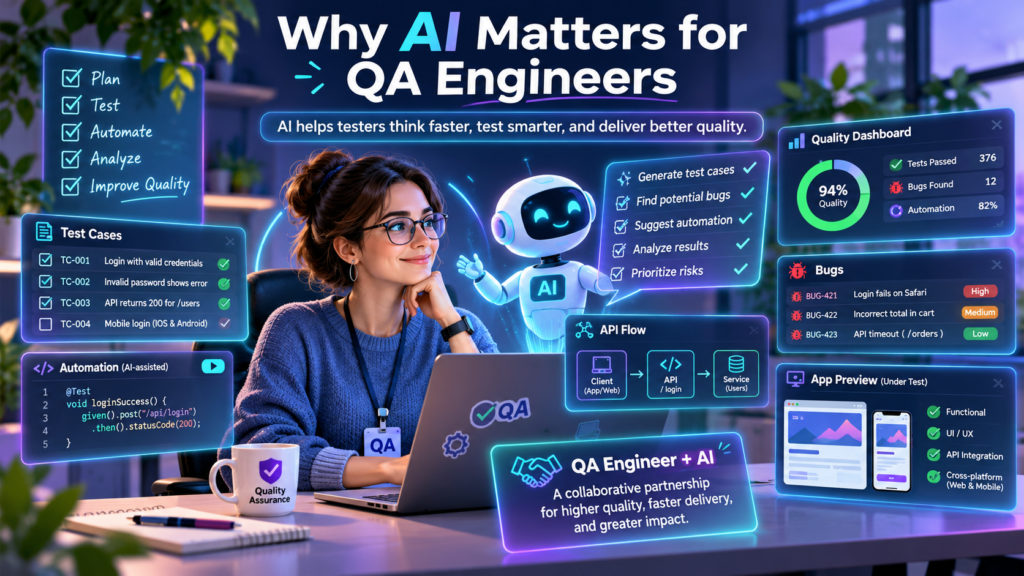
AI is changing software testing, but does that mean QA Engineers are becoming less important? I believe it’s actually the opposite.
If you’ve been working in software testing for a while, you’ve probably noticed how much our industry has changed.
I remember when most of our testing was manual. We spent hours writing test cases, executing regression tests, documenting bugs, and checking whether applications behaved as expected.
Then test automation became increasingly important. Tools like Selenium, Cypress, and Playwright helped us automate repetitive tasks and improve testing efficiency.
Now we’re entering another major shift: Artificial Intelligence (AI).
And this time, the changes could be even bigger.
As someone who has spent nearly 20 years working in Quality Assurance, I’ve seen technologies come and go. Some made our lives easier. Others introduced new challenges.
But AI feels different.
It’s not just another testing tool. It has the potential to change how we approach software quality altogether.
Let’s talk about why AI matters for QA Engineers and why I believe we should start embracing it today.
1. AI Is Not Here to Replace QA Engineers
One of the biggest concerns I hear from people in our industry is:
“Will AI replace software testers?”
My answer is simple: AI will change our jobs, but that doesn’t mean the QA profession is going away.
Think about what makes a good QA Engineer.
It’s not just knowing how to execute test cases or write automation scripts.
It’s about understanding business requirements, identifying risks, questioning unexpected behavior, and thinking about scenarios that developers or business analysts might have missed.
AI can generate test cases, suggest automation scripts, and analyze requirements.
But it doesn’t automatically understand the full business context, the history of a project, or why a particular workflow matters to the customer.
That’s where experienced QA Engineers remain essential.
AI can help us test faster, but human judgment helps us test the right things.
2. Less Time Writing Test Cases, More Time Thinking About Quality
Let’s be practical.
How much time do we spend writing test cases?
Sometimes we receive a Jira ticket with a description and acceptance criteria, and we spend a significant amount of time creating test scenarios.
Now imagine giving that information to an AI assistant and asking it to generate an initial set of test cases.
Within seconds, you might receive suggestions for:
- Positive and negative testing scenarios.
- Boundary value analysis.
- Missing acceptance criteria.
- Edge cases that weren’t initially considered.
- API validation scenarios.
- Regression testing coverage.
Does that mean we should copy everything AI generates into Jira or Xray?
Absolutely not.
AI-generated test cases still need to be reviewed. Some will be useful, others will be redundant, and some may completely misunderstand the requirement.
But instead of starting from a blank page, we have something to work with.
For me, that’s one of the biggest advantages.
AI should reduce repetitive documentation work so QA Engineers can spend more time analyzing risks and finding real defects.
3. AI Makes Test Automation More Accessible
Not every QA Engineer is a strong programmer.
And that’s perfectly fine.
There are excellent manual testers who understand business processes much better than some automation engineers.
The challenge is that automation has become increasingly important in modern development teams.
This is another area where AI can make a difference.
Today, tools like ChatGPT, GitHub Copilot, and other AI coding assistants can help QA Engineers:
- Generate initial Playwright or Selenium scripts.
- Understand unfamiliar programming code.
- Create API test examples.
- Debug failing automation tests.
- Improve test scripts and reduce duplication.
- Learn JavaScript, Python, or other programming languages.
For example, imagine you’re testing a login page and need to automate the following scenario:
Verify that a user cannot log in with an invalid password.
You can describe the scenario to AI and ask it to generate a Playwright test.
AI can provide a starting point, explain the code, and help you refine it.
But here’s something important.
Just because an AI-generated script runs successfully doesn’t mean it’s a good test.
You still need to understand the assertions, expected results, test data, and potential weaknesses.
AI can help you write automation, but you remain responsible for validating what the automation actually tests.
4. Better Bug Reports and Faster Defect Analysis
Every experienced QA Engineer knows that finding a bug is only part of the job.
Explaining it clearly is equally important.
We’ve all seen bug reports with vague descriptions like:
“Page doesn’t work.”
Or:
“System showing wrong information.”
These reports make developers’ lives difficult and slow down defect resolution.
AI can help improve bug reporting by organizing the information into a clear structure:
- Summary of the problem.
- Preconditions.
- Steps to reproduce.
- Actual result.
- Expected result.
- Relevant technical information.
AI can also help analyze logs, compare API responses, and suggest possible causes of unexpected behavior.
However, we need to be careful.
AI might suggest an explanation that sounds convincing but is technically incorrect.
For that reason, QA Engineers must always validate the evidence before reporting a suspected root cause.
A well-written bug report helps the entire team, but accuracy is more important than presentation.
5. AI Can Help Us Identify Testing Gaps
This is one of the areas I find most interesting.
In complex enterprise applications, a change to one feature can affect several other parts of the system.
For example, imagine an application where a user creates a purchase order, sends it to an external supplier system, receives a confirmation, and later amends the order.
Now imagine a developer changes the logic controlling when that purchase order can be sent.
A QA Engineer needs to consider more than whether the Send button works.
We also need to ask:
- What happens if the order hasn’t been approved?
- What happens if the supplier rejects the order?
- What happens if the external API is unavailable?
- Can the same order be sent twice?
- What happens when the order is amended?
- Does the database correctly reflect the status?
- Could this change affect another integration?
AI can assist with identifying dependencies and proposing additional scenarios.
It may highlight possibilities we haven’t considered.
Of course, AI won’t magically know every integration or business rule. We need to provide the relevant context and verify its suggestions.
But used correctly, it can become a valuable brainstorming partner.
The value isn’t simply generating more test cases. It’s discovering important scenarios that might otherwise be missed.
6. AI Doesn’t Replace Exploratory Testing
I strongly believe exploratory testing will remain one of the most valuable skills in Quality Assurance.
Why?
Because software doesn’t always fail in predictable ways.
Sometimes the most serious defects are discovered when a tester starts exploring the application, combining unusual workflows, changing data, or questioning behavior that doesn’t make sense.
AI can suggest exploratory testing charters and possible risk areas.
But the human tester brings curiosity, intuition, and practical experience.
For example, an experienced tester might notice that a calculated percentage appears correct initially but becomes incorrect after changing a supplier quantity.
That tester may then investigate how the application recalculates values across different workflows.
This type of investigation requires more than simply following predefined steps.
It requires critical thinking.
And that’s something QA Engineers should continue developing, regardless of how powerful AI becomes.
7. QA Engineers Need to Learn How to Work With AI
Here’s something I believe every QA Engineer should understand.
You don’t need to become an AI expert, but you should understand how to use AI effectively in your daily work.
Start small.
Use AI to review a requirement. Ask it to identify missing scenarios. Let it help you understand an unfamiliar API response or automation script.
Experiment with it.
But don’t become dependent on it.
One of the biggest risks is accepting AI-generated results without questioning them.
I’ve seen how easy it is for AI to produce something that looks professional and technically correct while missing important business rules.
As QA Engineers, questioning assumptions is already part of our job.
We should apply that same mindset when working with AI.
Treat AI-generated output like any other unverified input.
Review it, challenge it, and validate it.
8. The Future QA Engineer Will Combine Experience, Automation, and AI
I believe the QA Engineer of the future will need a combination of three important skills:
Business and testing knowledge
Understanding requirements, customer expectations, risks, and how different systems interact.
Technical and automation knowledge
Being comfortable with APIs, databases, automation frameworks, logs, and modern development processes.
AI-assisted working skills
Knowing how to use AI to improve productivity, analyze problems, generate useful starting points, and accelerate learning.
Not everyone needs to become